Wednesday, July 25, 2018

Keeping a Nature Journal

6102i ycPpLKeeping a Nature Journal – Discover a Whole New Way of Seeing the World Around You
Written by Clare Walker Leslie & Charles E. Roth
Published at Storey Publishing

About the book

Experience the splendor of nature with fresh eyes! Featuring an inspiring portfolio from Clare Walker Leslie’s nature journals, this guide offers easy-to-learn techniques for capturing the world around you in pictures and words. Encouraging you to make journaling a part of your daily routine, Keeping a Nature Journal is full of engaging exercises and stimulating prompts that will help you hone your powers of observation and appreciate new aspects of nature’s endlessly varied beauty.

My Thoughts

I have been doing bible art journaling for a few years now and as time goes by I am always eager to learn new techniques on drawing.   I have been seeing this particular book numerous time through the years but never ended up getting it.   I got the opportunity to review it and I have learned quite a bit while reading and trying the techniques presented in the book.    This is the 2nd edition of the book and in includes 32 pages of color portfolio from Clare’s latest journals.   Most of the rest of the book is black and white drawings. 

This book will open up a whole new way to look what is going on around you.  Personally, I find it peaceful and relaxing to sit down with a sketch book and draw.   The book is divided into four parts.  Part One will guide you on how to get started.  And please do not give me the excuse that you are not skilled whatsoever in drawing.  I, myself, is the perfect example in how someone can develop the skills and draw better.  I remember when I was in high school and I disliked my art classes.   It was always difficult for me that year to get better….  But unbeknown  to be the genes in my body would blossoms when I would be in my…. wait for it….. FORTIES!   Yes you have read this right.  I have learned to enjoy drawing and painting in my forties and as I am at the edge of turning fifty next year, I am looking forward to see how this journey will develop itself in the years to come.

Part Two will provide plenty of tips and tricks to draw through the seasons – whether you decide to do an ongoing journal or specific season journals.  Part Three presents the new selection of pages from Clare’s journals this time in color.   Finally Part Four is giving you a lesson on how to enjoy and develop the skill of nature journaling.  You cannot miss the examples and techniques presented.  One thing I will tell you is that practice makes you better as time goes by.  So do not hesitate a minute and grab this book, a sketch book and pencils to practice drawing.

I was inspired by one of the examples found in the book.  The tree presented looked as though it was a spring or summer image.  However, I decided to change it a bit and create a more late fall/winter image.   I am quite pleased with the result.

IMG_0537IMG_0536

Another thing that I think is great for this book is that at the end of the book you can have a suggested scale for teachers to assess nature journaling skills.   As a homeschooler I think it is fabulous to have guidance of this sort because it can be difficult to grade assignments.  

This book is definitively a great resource to have if you desire to develop a new skills, if you desire to be better at drawing, if you homeschool, or if you do bible art journaling (because like it or not nature is perfect to illustrate verses!).  

The book Keeping a Nature Journal is available to purchase at your favorite bookstore, even on amazon.ca and amazon.com.


Disclaimer: Thanks to Thomas Allen for sending me the above mentioned book for review purposes. I was not monetarily compensated for this review. Please note that the review was not influenced by the Sponsor in any way. All opinions expressed here are only my own.

The Beginner’s Guide to Dehydrating Food

61W1aVDsFkLThe Beginner’s Guide to Dehydrating Food – How to Preserve All Your Favorite Vegetable, Fruits, Meats, and Herbs
Written by Teresa Marrone
Published at Storey Publishing

About the book

This essential companion for putting your food dehydrator to work features instructions and techniques for drying all the most popular fruits and vegetables, along with meat and herbs. You’ll learn to dry fruits and vegetables at their peak, giving you an easy and economical way to stock your pantry with apple rings, mango slices, banana chips, dried soup beans, tomatoes, and much more for year-round enjoyment. In addition, drying guidelines for specialty items like meat jerky, fruit leather, dried herb and spice mixtures, backpacking meals, and even baby food round out this friendly handbook.

My Thoughts

We have purchased a stackable-tray dehydrator a few years ago.  Our goal was to be more versatile in storing food and explore the possibility of dehydrating food.   We didn’t know how to do it properly and got discouraged…  We kept the dehydrator and used it sporadically when drying nuts which make them crunchier.  But when I stumbled on this book my interest in using the dehydrator more often and for a variety of food got sparked again.   I was delighted to receive this book to review and was not disappointed with what it had to offer.

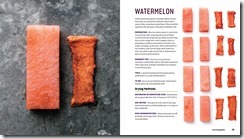
The book is divided into three parts.  Part One will introduce you to the techniques for drying food at home and the different methods and equipment that can be used. Part Two will show you how to dehydrate the fruits and vegetables, the herbs and spices as well as meat and poultry.   This section will go through detailed explanation for each food included like mangoes, or watermelon, asparagus or peas and so on.   For each food item presented in this book, you will learn how to prepare it, how to verify if the dehydration is done, how much it will yield, how to use it.  You will also discover which drying methods are the best for the food in question.

91-GEr UlGL91ZPBbzaOVL

91slGwpmueL81sCH3XglEL

The third section of the book will encourage you to make the most of your dehydrator.  You will learn how to make leather or candied fruits.  You will also have a whole chapters with recipes using the food you have dehydrated.

You do not need a dehydrator to make this book a great reference in your kitchen.  Why?  Because the author also gives instruction on hos to dehydrate using your beloved oven or in the case of herbs, how to dry them in the air.

I wanted to try something new – no nuts this time…   A friend had given us some rhubarb and there was quite a bit of it.  I quickly checked in the book and rhubarb did have some instructions.  So I followed the instruction on how to cut my rhubarb stalks.  And programmed the dehydrator to dry it.

IMG_0438

It took between 6-10 hours to dry the pieces of rhubarb.

IMG_1099

Once dried, you can store it in jar for future use.  You can rehydrate them for sauces, pies, or other cooked dishes by simply pouring boiling water using the ratio suggested in the book.  

IMG_1100

What I particularly like about this book is that for each food item presented in it, you can visualize the before and after because a picture is include for each.    That way you know exactly what to expect when drying your food.   It is a great book to own if you like doing these kind of things.   I think it has tremendous potential for any household.   I am looking forward to use this book more often during the fall season.   It can be very useful as well if you decide to purchase riper than usual fruits and vegetables from the market at a reduce price.   We often take advantage of this for peppers or avocados.   Having this book opens up new possibilities for us.


Disclaimer: Thanks to Thomas Allen for sending me the above mentioned book for review purposes. I was not monetarily compensated for this review. Please note that the review was not influenced by the Sponsor in any way. All opinions expressed here are only my own.

Tuesday, July 24, 2018

Smithsonian Maker Lab Books

DK has published some very neat book on science in partnership with the Smithsonian.  Each of the books contains some fun experiments that can be done at home.   I had the opportunity to review two of these books.

A1jmsDsIpkLMaker Lab – 28 Super Cool Projects offers step-by-step activities appropriate for kids ages 8–12.  Each activity is ranked easy, medium, or hard, with an estimated time frame for completion. Each of them also require only household materials that your children can use to build an exploding volcano, race balloon rocket cars, construct a solar system, make a lemon battery, and more.   The book contains four sections: Food for Thought, Around the Home, Water World, and The Great Outdoors.   Each of the experiments included in this book will open up the world of science for your child.

812NN8CR7iL

Maker Lab Outdoors – 25 Super Cool Projects contains projects that focus on Earth and the environment, plants and animals, weather, water, and physics, bringing science learning home and into the backyard. Young 91Mt4cVCszLscientists can build a wormery and learn about compost, crack rocks with water and learn about freezing and thawing, build and launch a water rocket to see Newton's laws in action, and more.  Through the pages of this book you will have the possibility to explore nature in ways that are mind blowing.  The child will be encourage to experiment with nature watch, with the world of weather, with water power and with earth and sky. 

91DRhwRQYJL 91hv6WINq L 918SNsI3LbL

My Thoughts

What I like about the DK books is that not only does it gives the instructions to complete an experiment but it also explains the science behind it.  Both books also have incredible photography to illustrate the experiments.  A step-by-step comprehensible instructions and detailed explanations make these books a must for fun activities to do with your kids.   There are even explanations on how it works and real-word science tidbits to make the child realize that you can find the reaction of the experiment in the real world.

One of the book also contains experiments done with food – like the baked Alaska for example.  It is an amazing way to make the child to make food and also discover the science behind it.   Seeing the instructions makes it possible to do it without worrying to mess it up.   It is a more difficult experiment for sure and I would strongly suggest the presence of an adult when doing it but reading the science behind it will encourage you to do a little magic trick for your family one evening.   A cool magic trick if you ask me.  Your kids won’t believe their eyes when the ice cream won’t melt when you put the cake in the oven!  Not only will you be able to explain why the meringue acted as an insulator for the ice cream but you will be able to tie this to the awesome explanation why igloos do keep the warmth as well.

These books are also great to keep your kids busy during the summer months or during PD Days or holidays.    Nothing can build more memories than to spend time with your children doing quick and fun experiments and discover why it does what it does.  

915KGosHnYLAnd if these two books are not enough, DK also has published a Star Wars Maker Lab which contains 20 amazing projects.  This specific book will teach your budding Padawan how to become a Master of science, in both the real world and the Star Wars galaxy. Using clear step-by-step instructions, the book guides home scientists and makers through each exciting experiment–from making Jabba's gooey slime or a hovering landspeeder, to an Ewok catapult and a glowing Gungan Globe of Peace. Each experiment has fact-filled panels to explain the real-world science as well as the Star Wars science fiction from the movies.

71hxT8eHAeL  71C5hPtRWSL

These books are available at your favorite bookstore, even on amazon.ca and amazon.com.


Disclaimer: Thanks to DK Canada for allowing me to promote their books. I was not monetarily compensated for this post . Please note that the post was not influenced by the Sponsor in any way. All opinions expressed here are only my own.