Showing posts with label Birdwatching. Show all posts

Wednesday, March 13, 2019

Owling


Owling: Enter the World of the Mysterious Birds of the Night
By Mark Wilson
Published at: Storey Publishing
About the book
From Hedwig, the Snowy Owl of Harry Potter fame, to Winnie-the-Pooh’s beloved friend Owl, this wide-eyed bird of the night has found its way into young hearts and imaginations everywhere. Owling invites young readers into the world of real-life owls, to learn about their fascinating behaviors and abilities. 

Wildlife photojournalist and nature educator Mark Wilson presents a one-of-a-kind look into the mysterious lives of these distinctive birds. Dramatic images of the 19 owl species of North America nesting, flying, hunting, and catching prey are accompanied by information about the birds’ silent flight, remarkable eyes and ears, haunting calls, and fascinating night life. Kids will learn how to spot owls; identify their calls, plumage, and pellets; and even carry on a hooting conversation with a nearby owl.

My Thoughts
My daughter has fallen in love with owls ever since she read the book series titled Guardians of Ga’Hoole.  To be honest I have lost count how many times she has read this series in the past two years.  Every time she sees something that is owl related she is delighted.  More recently, we had the privilege to see a snowy owl in a field near our home as we were going to church.  My daughter was all excited to have seen one in the wild.


She isn’t the only one who enjoy seeing owls.   I love anything related to bird watching. Needless to say that having the opportunity to review Owling is extra special in this household because I know that my daughter will particularly like this book.

The book is packed with information concerning owls.   The table of contents is very precise in what it covers.

  • Chapter 1: All About Owls – This chapter will present you information about owl like the parts of an owl head, it’s body parts, the fact that owls can turn their head in circle, their eyes, night vision, hearing, their predatory skills, their flight, their feathers, their feet, their beak, and so on.
  • Chapter 2: Introducing the Owls – This chapter starts with the scientific names for owls and then jump directly in presenting all the different owls we can see in the wild,  More specifically, you will learn about Owls of North America, Barn Owl, Flammulated Owl, Western Screech-Owl, Eastern Screech-Owl, Whickered Screech-Owl, Great Horned Owl, Snowy Owl, Northern Hawk Owl, Northern Pygmy-Owl, Ferruginous Pygmy-Owl, Elf Owl, Burrowing Owl, Spotted Owl, Barred Owl, Great Gray Owl, Long-eared Owl, Short-Eared Owl, Boreal Owl, and Northern Saw-whet Owl.  For each of these owls, you will learn their scientific name, their old names, how to identify them, their range and habitat, their voice, their nesting behavior, their hunting habits and their menu. 
  • Chapter 3: How to Find Owls – This chapter will allow you to discover when and how to find owls in the wild. You will also learn about owl pellets and how to build an owl house.
  • Chapter 4: Working with Owls – This chapter will present you all the different jobs that allow someone to work close to owls whether you are a wildlife specialist or an artist.


The book also includes a glossary, a list of places to see owls in captivity. an index as well as a metric conversion chart.  Just to give you an idea of what the pages look like in the book check the pages below.


As you can see this book contains numerous pictures, a ton of information as well as fascinating facts about owls.   It would make a wonderful gift to someone who enjoy birds in general or is a fan of owls of all sorts. This book is also great for someone who desire to make a school project on owls.,,It is a fabulous reference when studying birds.

Owling is available for purchase at your favorite bookstore, even on amazon.ca and amazon.com.


Disclaimer: Thanks to Thomas Allen for sending me the above mentioned book for review purposes. I was not monetarily compensated for this review. Please note that the review was not influenced by the Sponsor in any way. All opinions expressed here are only my own.




Monday, June 4, 2018

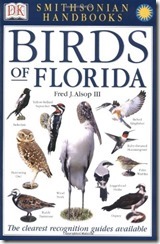
Birds of Florida

51uGmMbopxLBirds of Florida
By Fred J. Alsop III
Published at DK

About the book

The most comprehensive series of field guides to North American birds ever. This impressive collection highlights birds from all regions of the United States including localized areas such as the Mid-Atlantic, the Pacific Northwest and New England. Whether birding in the foothills of New England, the prairies of the Midwest, or the beaches of Florida, Smithsonian Handbooks are the most comprehensive field guides to North American birds on the market. Looking for the Great Blue Heron or the Piping Plover while visiting the Great Lakes? Desperate to find the rare Long Billed Curlew or the Marbled Godwit during a hike in the Cascade Mountains? There's no need to look any further! Created in association with the Smithsonian Institution, these amazing guides are an absolute staple for any birder or amateur ornithologist. Each local species receives its own profile, along with descriptions of habitats and annotated photographs that highlight specific characteristics and other points of interest. Take bird watching to new heights!

My Thoughts

As I mentioned in a previous post, our family will be driving to Florida sometime this summer.  And being the kind of person who enjoy learning more about the animals and birds I decided it would be fun to discover some of the birds that we might encounter while there.   This is why I requested the book Birds of Florida which is part of the Smithsonian Handbooks published at DK.

This book is packed with beautiful birds that can be seems in Florida or on the coast of this state.   The first 35 pages of the book will explain how the book works and the visual references within the book.  Then you can discover more about the anatomy of birds along with the different part of a bird on a two-page presentation. The book also highlights the variations within species, how to identify birds, how to identify birds in flight, their silhouettes, behavior, how to do birdwatching and how to be a better birder.   Once you have read these pages, you can start exploring Florida in order to discover the birds in the book.  Make sure you bring binoculars as well when your are going out that way you won’t miss any beautiful specimen that might come across your path.

Each pages included in this book contains photographs, illustrations, a list of similar birds, a distribution map with indication as to if the bird is a permanent resident/summer resident/winter resident, flight patterns, nest identification, habitat, and much more.

image

This book is definitively the kind of book I would bring when visiting a state.   The fact that is contains specifically the bird found in Florida is particularly nice because that means that the book is easy to carry.  Mind you it contains over 400 pages so it is quite thick but the size is perfect to slip it in a backpack.  No matter where we are, I will bring this book with us at all times.  As a matter of fact, I plan to leave it in the truck so that way we will not forget it when we leave the RV.   That way it will always be available for us to check it.   I also plan to bring it with us when we go on the coasts to go to the beach.  

Needless to say for Floridians or visitors that enjoy birds, this book is definitively a must have.   And even if you go to Florida for a few weeks, you can always leave the book behind for someone else to use it.    I am looking forward to discover the birds of Florida with my family – especially since we will be camping in state parks which I suspect will have some birds to observe.

Birds of Florida is available for purchase at your favorite bookstore, even on amazon.ca and amazon.com.


Disclaimer: Thanks to DK Canada for allowing me to promote these books. I was not monetarily compensated for this post . Please note that the post was not influenced by the Sponsor in any way. All opinions expressed here are only my own.

Friday, June 3, 2011

Bird view on robins

Robins are well known birds in our city.  No matter where you go you will find one on a branch or trying to grab a worm…

But what do they look like at the various stages of their life?

This year, I was blessed to see some fresh robin’s eggs in a nest on my neighbour Japanese Lilac.   I wish the robins had build their nest in mine but I am glad I can access it with a small ladder.

I saw mama bird building the nest over the past couple of weeks.  Last week, she was still at it.  Putting mud and other things.  Gently building it.    I thought I would wait a few days and go take a peek to see if there were some eggs.  *grin*   I never saw a robin’s egg before.  Seen it in pictures yes but seen it in the outdoors would be simply amazing… 

So this morning, I took the little ladder out of the furnace room in the basement and took it outside with my camera.   I climbed carefully.   Mama bird didn’t like this.   She flew out in the hopes that I would follow… I kept an eye on her and heard her cries.   She wasn’t happy whatsoever.   Carefully, I pulled a few branches and looked in the nest.  Two eggs.   Beautiful robin blue eggs.   I snapped a few pictures and came back down.   Dominic my child who loves animals big and small wanted to see.  He went up and peeked in.   He quickly came back down and was very happy to have seen them.  I think we were both blessed to have seen them…

RobinEggs

Last year, as we were driving to Boston for a few days of vacation, we stopped at a campsite in New York State.    In the play structure, there was a nest with baby birds in it.   I wasn’t sure which kind of birds they were.   After searching a bit I discovered that they were baby robins.     I snapped some pictures, told the kids to be careful and not touch them.

2010_05_17_19_34_262010_05_17_19_34_14 - modified

Even my then 2 years old daughter Jasmine observed them carefully!

2010_05_18_09_35_02

10 days later, we were back at the same campground for a night.   We wondered what the robins looked like.    So we ventured close to the play structure.  One flew out.   The others stayed in the nest.   Juvenile robins they were already.  In a matter of 10 days, they had outgrown their nest.   Impressive don’t you think?

2010_05_27_16_31_10

According to the Audubon Guide on Birds app, the American Robin (scientific name Turdus migratorius) can be found in Canada during the summer and is a resident of all of the USA (well almost all…. except some areas which are probably too hot for the bird).    It belongs to the family of Trushes.   Its colors are gray on the top and some red on the chest.   The head and tail of the males are black and dull gray for the females.   Younger birds will have spots on their chest.

Their song is a series of rich caroling notes, rising and falling in pitch sort of saying “Cheer-up, cheerily, cheer-up, cheerily!”.IMG_7126

You can find this bird in towns, gardens, open woodlands and agricultural land. 

The nest will contain 3-5 blue-green eggs in a well-made cup of mud reinforced with grass and twigs, lined with softer grasses, and placed in a tree or on a ledge or windowsill (see picture on the side).  Robins apparently have two broods a season.   The iBirdPro app also specifies that the incubation period ranges from 12 to 14 days and is carried out bu the female.

America Robin is known in French as a rouge-gorge or merle d’Amérique.   It feeds on wild and cultivated fruits, berries, earthworms, and insects such as beetle grubs, caterpillars, and grasshoppers.

If you feel like watching a Robin’s nest online these days, check out BirdCam.ca and keep your eyes open.  You might see some baby birds soon…